


Why ZIP Code-Level Visibility Feels More Natural Than Social Media Ads
Social media and streaming media create very different visibility environments. Understanding those differences helps explain why ZIP code-level visibility often feels more familiar to audiences than traditional social media advertising.
The way people encounter advertising has changed dramatically over the last decade.
For many people, social media has become one of the most common places to see promotions, sponsored content, and advertising messages. Whether someone is scrolling through Facebook, Instagram, TikTok, LinkedIn, or another platform, advertising is often blended directly into the content stream.
Most users understand this. In fact, many people have become remarkably good at identifying sponsored content almost instantly. A quick glance at a post, image, or video is often enough to determine whether it is advertising or organic content.
Streaming media creates a different experience.
When people sit down to watch a streaming program, they are typically focused on the content they intentionally selected. A television show, movie, documentary, sporting event, or news program becomes the primary focus of attention. Advertising appears within that environment rather than competing directly with a rapidly moving content feed.
This difference may help explain why ZIP code-level visibility often feels more natural to audiences.
ZIP Code TV (ZTV) is built around geographic visibility. Messaging is delivered within selected ZIP code areas, allowing viewers throughout a defined geographic region to encounter the same brand, organization, campaign, or message over time. Rather than appearing between personal updates, comments, and conversations, the visibility occurs within a streaming environment that audiences have long associated with television viewing.
For many people, television advertising feels familiar because it has existed for generations. The platforms may have changed, but the basic viewing experience remains recognizable. People watch programming. Advertising appears during breaks. The program continues.
Social media operates differently because the audience is actively navigating the platform. Every swipe, scroll, click, reaction, and comment changes the experience. The environment is dynamic, personalized, and constantly evolving.
Streaming visibility tends to be more consistent. A viewer watching a program today may encounter a similar viewing experience tomorrow or next week. The surrounding environment changes less dramatically than a social media feed, which can look completely different from one session to the next.
This consistency plays an important role in geographic visibility.
ZIP code-level visibility is not necessarily designed around immediate action. Instead, it focuses on audience exposure within a specific geographic area. Residents throughout a selected ZIP code may encounter the same message repeatedly while consuming streaming content over time. Familiarity develops through presence rather than interruption.
That does not mean social media is ineffective. The two environments simply create different visibility experiences.
One operates within a rapidly changing stream of user-generated content. The other operates within a structured viewing environment built around long-form programming.
As streaming adoption continues to expand, many organizations are exploring new ways to establish visibility within defined geographic areas. ZIP Code TV represents one approach to achieving that visibility while maintaining a viewing experience that feels familiar to many audiences.
The distinction is not necessarily about which platform performs better. It is about understanding how visibility is experienced. For many viewers, the experience of seeing a message within a streaming environment often feels different than encountering one while scrolling through a social media feed.
If you want to explore how ZIP Code TV (ZTV) visibility could apply to your business, campaign or local market strategy, request a quick call.
Simple conversation. Strategic focus.

Why Repeated Visibility Still Works
Repeated visibility remains one of the most consistent principles in advertising because recognition develops over time. Familiarity often grows through exposure long before a customer is ready to act.
There are certain ideas in marketing that continue to survive every new trend, every new platform and every new technology shift. Repeated visibility is one of them.
The reason is fairly simple. Human behavior hasn't changed nearly as much as the tools we use to communicate.
Think about the businesses you remember most easily in your own community. In many cases, they aren't necessarily the businesses you've used most often. They may simply be the businesses you've seen most often. Their name feels familiar. Their logo looks recognizable. Their presence feels established.
That familiarity usually doesn't happen because of a single interaction.
It develops through repetition.
People pass a sign multiple times. They see a vehicle on the road. They notice a business mentioned by someone else. They encounter the name again in another setting. Eventually, recognition begins to form. The business stops feeling unfamiliar.
What's interesting is that repetition doesn't require constant attention from the audience.
Most people aren't actively studying advertisements. They're living their lives. They're driving to work. Watching television. Running errands. Spending time with family. Visibility often happens in the background while attention is focused elsewhere.
Yet the exposure still accumulates.
A familiar name tends to feel different than an unfamiliar one. When a need eventually arises, people often find themselves recognizing a business before they remember exactly where they encountered it. The visibility came first. The decision came later.
That's one reason repeated visibility continues to matter regardless of how advertising technology evolves. The channels may change, but recognition still depends on exposure over time.
ZIP Code TV (ZTV) is built around that principle.
ZTV: Cast The Net.
The objective isn't simply to appear once and hope for an immediate response. The objective is to establish visibility within specific communities and ZIP codes so familiarity has an opportunity to grow. Some viewers may take action right away. Others may not need the service for months. Both outcomes are normal.
Repeated visibility isn't about pressure.
It's about presence.
Businesses that remain visible give recognition an opportunity to develop long before the moment a customer needs them.
Interesting when you think about it.
If you want to explore how ZIP Code TV (ZTV) targeting could apply to your business, campaign or local market strategy, request a quick call.
Simple conversation. Strategic focus.

Streaming Visibility Is Quietly Reshaping Local Advertising
Streaming visibility isn't changing local advertising overnight. The shift is happening gradually as viewing habits evolve and attention moves toward connected television and streaming platforms.
Most changes in advertising don't arrive with much fanfare.
They don't announce themselves. They don't ask for permission. They simply begin happening in the background until one day people look around and realize the landscape has changed.
Streaming visibility feels a lot like that.
For years, local advertising followed a fairly predictable path. Businesses purchased newspaper ads, radio spots, direct mail campaigns, billboards and traditional television placements. Those channels became familiar because they were the options available at the time.
Today, something different is happening.
Households are spending more time with streaming platforms and connected television devices. People are consuming content on their own schedules rather than around traditional broadcast programming. The viewing habits themselves have changed, which means the visibility opportunities are changing as well.
What's interesting is how quietly the transition has occurred.
There wasn't a single moment where traditional advertising disappeared and streaming took over. Instead, the shift happened gradually. Households added streaming services. Viewing habits evolved. Devices changed. Over time, attention began moving in a different direction.
Advertising tends to follow attention.
That's why streaming visibility has become such an important conversation. It's not simply about technology. It's about understanding where people spend their time and how familiarity develops within modern viewing environments.
A homeowner watching a streaming platform in the evening may never think about advertising at all. They're simply watching a program they enjoy. Yet visibility is still taking place. Businesses are being seen. Names are being recognized. Familiarity is quietly developing in the background.
That's where ZIP Code TV (ZTV) enters the conversation.
ZTV: Cast The Net.
The concept is built around establishing visibility within specific communities and ZIP codes through streaming television environments. Rather than focusing only on immediate actions, the objective is to create opportunities for recognition and familiarity to develop where people already spend their attention.
In many ways, the shift isn't really about advertising.
It's about visibility.
The methods may change. The technology may evolve. Viewing habits may continue to move in new directions. Yet the underlying principle remains surprisingly consistent. Businesses benefit when they become familiar before they are needed.
Streaming visibility is simply the latest chapter in that story.
Interesting when you think about it.
If you want to explore how ZIP Code TV (ZTV) targeting could apply to your business, campaign or local market strategy, request a quick call.
Simple conversation. Strategic focus.

We Don't Drive Traffic. We Capture Eyes.
Traffic is often treated as the goal of marketing, but what happens before traffic ever occurs? This article explores why visibility, recognition and familiarity often develop long before someone clicks, calls or takes action.
One of the more common phrases in marketing is "driving traffic." Businesses want to drive traffic to their website. Marketers talk about traffic reports. Advertising campaigns are often measured by how much traffic they generate. There's nothing wrong with traffic. The interesting question is what happens before it.
Think about the businesses you recognize in your own community. Chances are there are companies you've never visited online, never called and never purchased from, yet you know exactly who they are. You've seen their trucks. You've passed their building. You've noticed their signs. Somewhere along the way, they became familiar.
That familiarity didn't come from traffic. It came from visibility.
That's an important distinction because visibility and traffic often get treated as if they're the same thing. They aren't. Traffic is an action. Visibility is a presence. Traffic can happen in an instant. Visibility usually develops over time.
A homeowner may not need a roofer today. A family may not be looking for a new restaurant this week. Someone may not be searching for a local service right now. That doesn't mean visibility has stopped working. In many cases, visibility is simply creating recognition in the background. The business becomes less of a stranger. The name becomes more familiar. Then, when the timing finally makes sense, recognition already exists.
That's one reason Aid-Local often talks about visibility differently. We don't drive traffic. We capture eyes.
Not because traffic doesn't matter, but because visibility often comes first. Before someone clicks, they usually notice. Before someone calls, they often recognize. Before someone takes action, they typically become familiar with the names around them.
ZIP Code TV (ZTV) is built around that idea.
ZTV: Cast The Net.
The goal isn't to pressure people into taking immediate action. The goal is to establish visibility within specific ZIP codes and communities where recognition has an opportunity to grow. Some people may act right away. Others may not think about the message again until months later. Both outcomes are normal.
Visibility isn't always about what happens today. Sometimes it's about becoming recognizable before tomorrow's decision ever arrives. Interesting when you think about it.
If you want to explore how ZIP Code TV (ZTV) targeting could apply to your business, campaign or local market strategy, request a quick call.
Simple conversation. Strategic focus.

The Difference Between Visibility and Traffic
Visibility and traffic are often discussed as if they're the same thing. They're not. One measures action. The other helps create familiarity long before action ever takes place.
One of the more interesting things about marketing is how often visibility and traffic get lumped together as if they're the same thing.
They're not.
The reason it's easy to confuse them is because both can play a role in growth. Both can be measured in different ways. Both can influence future business. But when you slow down and look at them individually, they're doing very different jobs.
Traffic is usually what gets the attention. Someone visits a website, someone fills out a form, someone clicks an advertisement or someone calls a business.
Those are actions, and actions are easy to see. They show up in reports. They create numbers. They give businesses something tangible to measure.
Visibility is different. Visibility often happens before any action takes place.
Think about businesses in your own community. There are probably companies you recognize even though you've never visited their website. You may have seen their trucks around town, passed their building countless times or noticed their signs while driving through the area.
You know who they are.
Not because you clicked on something, not because you searched for them, simply because they've been visible long enough to become familiar.
That's what makes visibility interesting.
It doesn't always announce itself with a measurable action. Sometimes it's quietly creating recognition in the background. The business becomes less of a stranger. The name starts to feel familiar. Then one day, when a need finally arises, that familiarity already exists.
A homeowner may not need a roofer today, a family may not be looking for a new restaurant this week, someone may not be searching for a local service right now, but that doesn't mean visibility isn't working.
It simply means the timing isn't there yet. Traffic measures movement, visibility measures presence but both have value and they shouldn't be confused with one another.
ZIP Code TV (ZTV) is built around that distinction.
ZTV: Cast The Net.
The goal is to establish visibility within specific communities and ZIP codes so familiarity has an opportunity to grow. Some people may take action immediately. Others may remember the name months from now when the timing makes more sense.
Interesting when you think about it.
If you want to explore how ZIP Code TV (ZTV) targeting could apply to your business, campaign or local market strategy, request a quick call.
Simple conversation. Strategic focus.
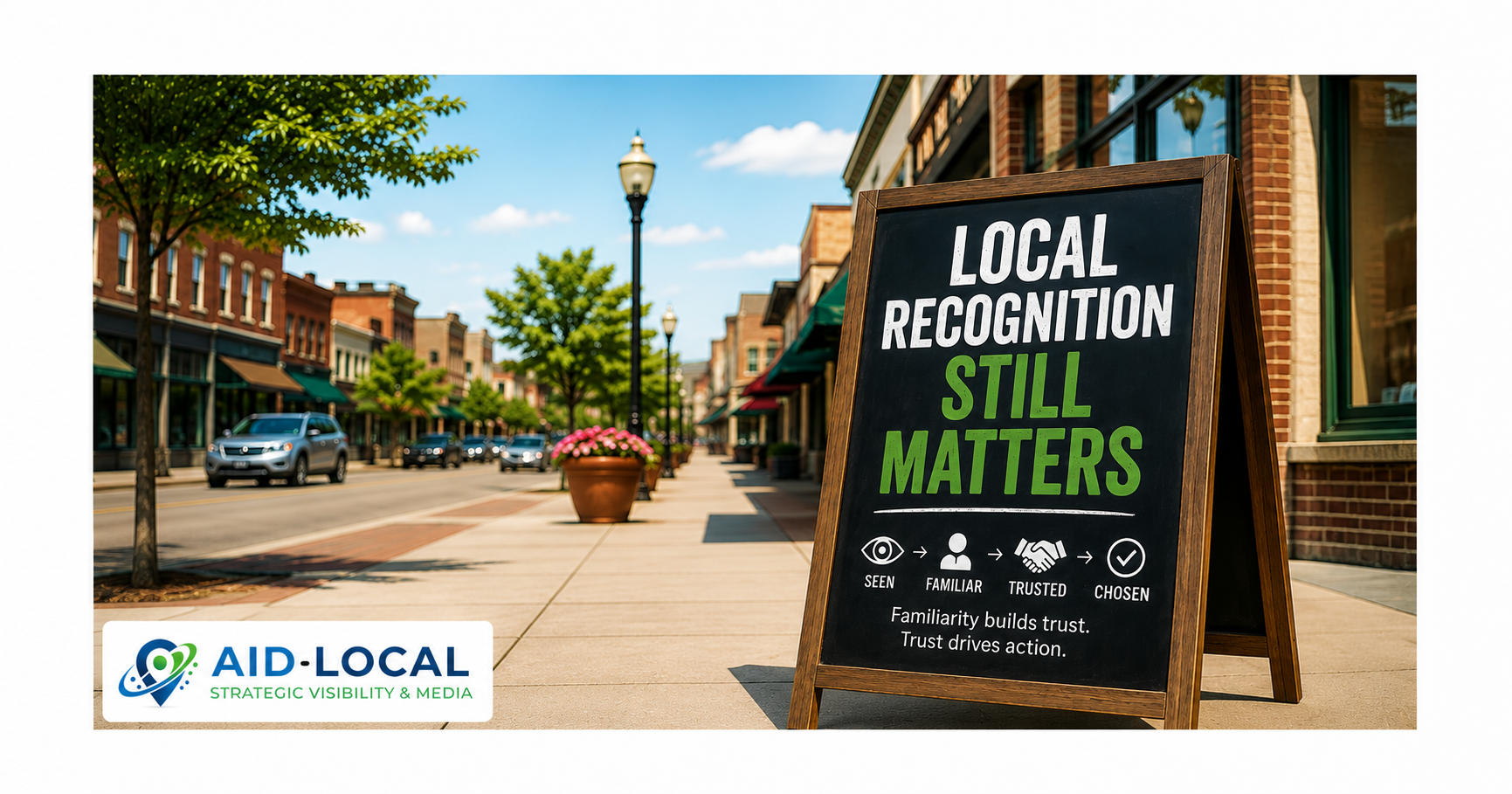
Why Local Recognition Still Matters
Local recognition isn't built through a single advertisement. It develops through repeated visibility over time, helping businesses become familiar, recognizable and easier to remember when people are ready to make a decision.
A lot has changed in advertising over the years.
People can search for businesses from their phones, compare options in seconds and read reviews before ever making a decision. With so much information available, it would be easy to assume that local recognition doesn't matter the way it once did.
The reality is a little different.
Local recognition still matters because people tend to be more comfortable with names they recognize than names they've never heard before.
Think about your own community.
There are probably businesses you know simply because you've seen them for years. Maybe you've driven past their building a hundred times. Maybe you've seen their trucks around town. Maybe you've noticed their advertisements without ever paying much attention to them.
You may have never become a customer.
You may have never visited their website.
Yet if someone mentioned their name, you would know exactly who they were talking about.
That's recognition.
And it didn't happen because of a single advertisement.
It happened because the business remained visible long enough to become familiar.
That's something many business owners overlook. They often focus on what happens after someone needs a service while forgetting everything that happens beforehand.
Before someone makes a decision, they usually become familiar with their options.
Before familiarity comes recognition.
Before recognition comes visibility.
The process is often much quieter than people realize.
A homeowner may not need a roofer today. A family may not be looking for a new restaurant this week. Someone may not be searching for a dentist right now.
That doesn't mean visibility has no value.
In many cases, visibility is simply laying the groundwork for future recognition.
That's one reason local visibility remains important even as advertising continues evolving. The platforms may change, the devices may change, the way people consume media may change but human behavior hasn't changed nearly as much. People still recognize what they repeatedly see.
ZIP Code TV (ZTV) is built around that idea.
ZTV: Cast The Net.
The goal is to establish visibility within the communities that matter most. Not because every exposure creates immediate action, but because repeated visibility creates opportunities for recognition.
And when recognition already exists, future conversations often become a little easier.
Local recognition isn't an old advertising concept.
It's a human one.
That's why it still matters.
If you want to explore how ZIP Code TV (ZTV) visibility could apply to your business, campaign or local market strategy, request a quick call.
Simple conversation. Strategic focus.

Visibility Before Action: Why Familiarity Matters
People rarely take action the first time they see a business, organization or message. Familiarity often develops through repeated visibility, creating recognition long before a phone call, website visit or purchasing decision occurs.
Most business owners want action.
They want phone calls. They want website visitors. They want appointments, customers and sales.
That's understandable.
After all, those are the things that keep a business moving forward.
What's interesting, though, is how often those actions begin long before someone ever picks up the phone or visits a website.
Think about businesses in your own community.
Maybe it's a local restaurant you've driven past for years. Maybe it's a roofing company whose trucks seem to be everywhere. Maybe it's the dentist whose sign sits near an intersection you travel through every day.
You may have never used any of them.
You may have never visited their website.
Yet you know who they are.
Why?
Because you've seen them.
Over and over again.
Not in an annoying way. Not because they chased you around the internet. They simply remained visible long enough to become familiar.
That's something many businesses overlook.
People rarely wake up one morning and suddenly trust a company they've never heard of. More often, familiarity comes first. The business becomes recognizable. The name starts sounding familiar. Then, when a need eventually arises, that business already has a small advantage.
It's no longer a stranger.
That's one reason visibility matters.
Not every advertisement is supposed to create an immediate response. Sometimes the value is much quieter than that. Sometimes the value is simply becoming recognizable within the communities you serve.
Over time, those moments of visibility begin to add up.
A homeowner may not need a roofer today. A family may not be looking for a new restaurant this week. A voter may not be paying attention to an election yet.
That doesn't mean visibility isn't working.
Familiarity often develops in the background.
By the time someone needs a service, wants more information or is ready to make a decision, recognition may already be there.
That's one of the ideas behind ZIP Code TV (ZTV).
ZTV: Cast The Net.
The goal isn't simply to chase immediate action. The goal is to establish visibility where familiarity has an opportunity to grow. Because when people recognize your business, your organization or your message, the conversation often starts a little easier.
Visibility comes first.
Action often follows later.
If you want to explore how ZIP Code TV (ZTV) visibility could apply to your business, campaign or local market strategy, request a quick call.
Simple conversation. Strategic focus.
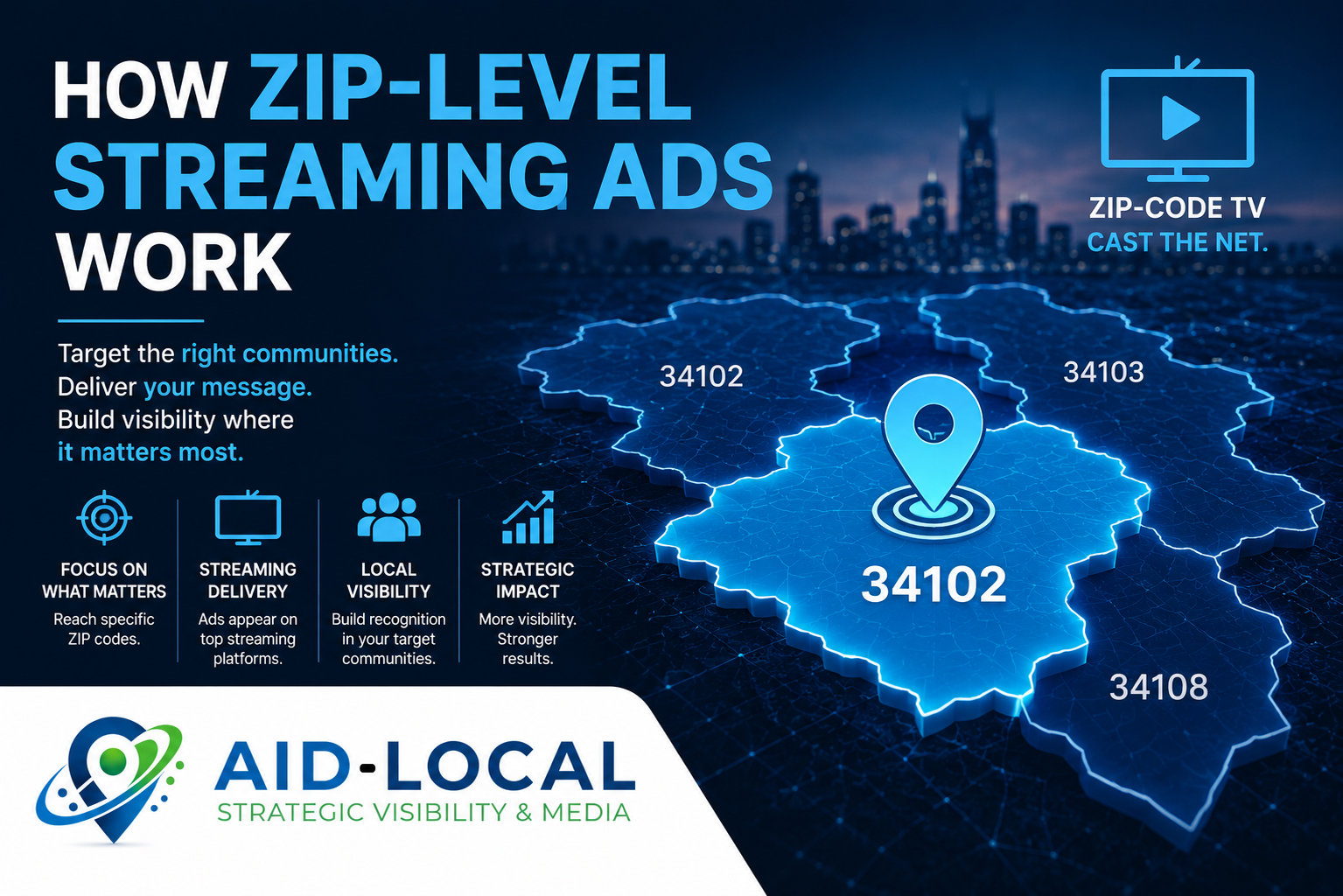
How ZIP Code-Level Streaming Ads Work
ZIP code-level streaming ads help businesses, organizations and campaigns focus visibility within specific communities instead of broad markets. Learn how geographic targeting delivers your message where it matters most.
Most people are familiar with the idea of television advertising.
A commercial appears during a program and anyone watching that channel has the opportunity to see it.
For decades, that was the standard approach.
The challenge was that advertisers often paid to reach large audiences regardless of whether those viewers lived inside the markets they wanted to reach.
Streaming media changed that equation.
Today, advertisers have the ability to focus visibility more strategically within specific geographic areas through ZIP code-level streaming advertising.
This is one of the core concepts behind ZIP Code TV (ZTV).
ZTV: Cast The Net.
Instead of purchasing visibility across an entire television market, ZIP code-level streaming visibility allows campaigns to concentrate exposure within selected ZIP codes.
In simple terms, the message is delivered where it matters most.
Businesses often serve specific service areas, organizations frequently focus on particular communities and political campaigns regularly prioritize defined voting districts and neighborhoods.
Not every message needs visibility across an entire city, county or region. Sometimes the goal is simply to establish familiarity within selected local markets.
ZIP code-level streaming visibility makes that possible.
When audiences within those selected ZIP codes consume streaming content across connected televisions, streaming devices and supported platforms, advertisements can be delivered within those geographic boundaries.
The objective is not necessarily immediate action, the objective is visibility. People tend to recognize businesses, services and organizations they see repeatedly over time. That recognition often develops before a phone call, website visit or purchasing decision ever occurs.
Visibility creates the opportunity for familiarity, familiarity creates the opportunity for trust and ZIP code-level streaming visibility is designed around that principle.
Rather than focusing exclusively on broad exposure, campaigns can concentrate visibility within the communities that matter most to their goals.
For some advertisers, this broader geographic approach is exactly the right fit. Others may eventually require more precise household-level visibility strategies through Close Reach TV (CTV). Both approaches exist within the same streaming environment.
The difference is visibility scope. ZIP Code TV (ZTV) focuses on geographic familiarity. The goal remains simple, be visible where your audience lives.
As streaming media continues growing, ZIP code-level visibility provides businesses and organizations with a modern way to establish recognition inside the communities they want to reach most.
If you want to explore how ZIP Code TV (ZTV) visibility could apply to your business, campaign or local market strategy, request a quick call.
Simple conversation. Strategic focus.
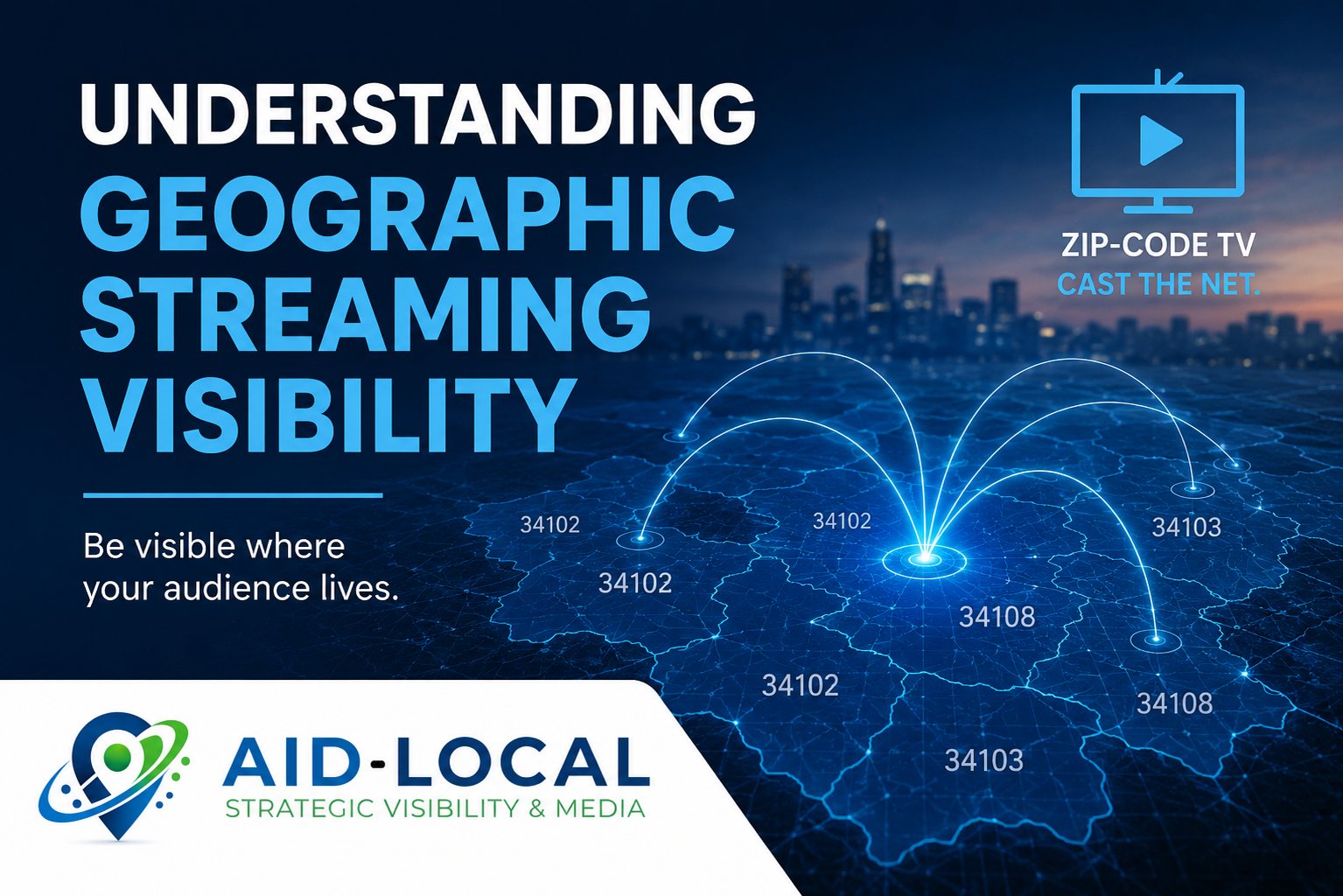
Understanding Geographic Streaming Visibility
Geographic streaming visibility allows businesses, organizations and campaigns to establish recognition within specific communities, service areas and ZIP codes. Learn how modern streaming media helps create visibility where your audience lives.
Understanding Geographic Streaming Visibility
For decades, local advertising was largely defined by geography.
Businesses advertised in newspapers that served specific communities. Radio stations reached particular markets. Television commercials were delivered across designated broadcast areas.
The goal was simple:
be visible where your audience lives.
While technology has changed significantly, that principle remains surprisingly consistent.
What has changed is how visibility can be delivered.
Today, streaming platforms allow businesses, organizations and campaigns to establish visibility within selected geographic areas without relying entirely on traditional media channels.
This approach is often referred to as geographic streaming visibility.
At its core, geographic streaming visibility focuses on delivering streaming advertisements to audiences within defined locations.
Those locations may include cities, neighborhoods, service areas or specific ZIP codes depending on campaign goals.
Rather than attempting to reach everyone everywhere, visibility is concentrated where it matters most.
That concentration often creates more meaningful recognition over time.
People naturally become more familiar with businesses and organizations they repeatedly encounter within their local environment.
The same principle applies to streaming media.
When visibility is consistently established within selected geographic areas, familiarity begins to develop.
That familiarity may not create immediate action.
However, recognition often begins long before someone makes a purchase, schedules a service, attends an event or contacts a business.
Visibility creates the opportunity for recognition.
Recognition creates the opportunity for familiarity.
Familiarity often creates comfort.
This is one of the reasons geographic streaming visibility continues gaining attention among businesses looking for alternatives to broad, generalized advertising strategies.
Through ZIP Code TV (ZTV), visibility can be focused on specific communities and local markets rather than entire regions.
ZTV: Cast The Net.
Instead of relying solely on who happens to be searching at a particular moment, geographic streaming visibility allows businesses to establish an ongoing presence within selected areas over time.
That visibility becomes part of the audience's environment.
As streaming media continues growing, local visibility opportunities continue evolving alongside it.
The technology may be different than traditional television, but the objective remains familiar:
be visible where your audience lives.
Geographic streaming visibility simply provides a modern way to accomplish that goal.
If you want to explore how ZIP Code TV (ZTV) visibility could apply to your business, campaign or local market strategy, request a quick call.
Simple conversation. Strategic focus.
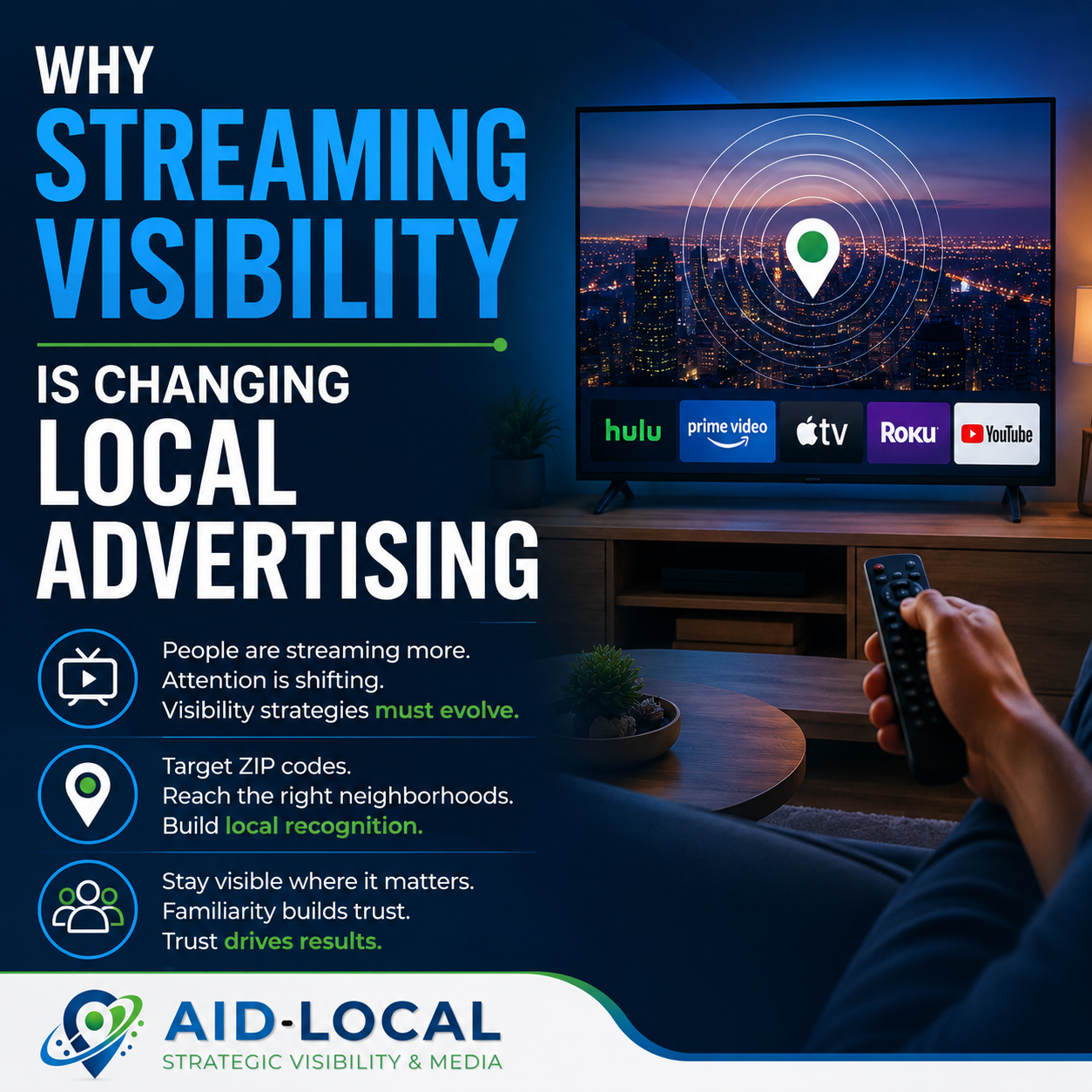
Why Streaming Visibility Is Changing Local Advertising
Streaming visibility is reshaping how local businesses, organizations and campaigns establish recognition within their communities. Learn why geographic streaming visibility and ZIP Code TV (ZTV) strategies are becoming an important part of modern local advertising.
The way people consume media has changed dramatically over the past decade.
Cable television once dominated household attention. Today, many people spend more time watching streaming content across smart TVs, tablets, phones and connected devices than they do watching traditional television programming.
That shift has quietly changed local advertising as well.
Businesses, organizations and campaigns are no longer limited to broad television markets or expensive traditional media buys just to establish visibility within their communities.
Streaming visibility has opened the door to something more strategic.
Instead of placing advertisements across an entire region and hoping the right audience sees them, businesses can now focus visibility more intentionally within specific geographic areas and audience groups.
That is one reason ZIP Code TV (ZTV) continues gaining attention.
ZTV: Cast The Net.
Streaming visibility allows businesses and organizations to establish presence within selected ZIP codes where familiarity and recognition matter most.
This changes the way local visibility can be approached.
For years, many digital advertising strategies became heavily focused on clicks, traffic spikes and immediate actions. While those things can have value, local recognition often begins long before someone decides to make contact, visit a business or take action.
People tend to trust what feels familiar.
Repeated visibility helps create that familiarity over time.
Streaming media allows businesses to remain visible inside the environments where people already spend significant amounts of time consuming content and entertainment naturally.
That visibility often feels less intrusive than many traditional online advertising experiences.
Instead of competing aggressively inside crowded social feeds or relying entirely on search behavior, streaming visibility helps establish calm, repeated audience presence across selected geographic areas.
As more viewers continue moving toward streaming platforms, local advertising strategies are evolving alongside them.
This does not mean traditional marketing disappears.
It means visibility opportunities are expanding.
Some campaigns may benefit from broader geographic visibility through ZIP Code TV (ZTV) strategies.
Others may eventually require tighter household-level visibility through Close Reach TV (CTV) approaches.
Both exist within the same evolving streaming environment.
The difference is strategic visibility focus.
Streaming visibility is not simply about chasing attention.
It is about remaining visible where recognition has an opportunity to grow naturally over time.
That shift is changing local advertising quietly, but significantly.
If you want to explore how ZIP Code TV (ZTV) visibility could apply to your business, campaign or local market strategy, request a quick call.
Simple conversation. Strategic focus.
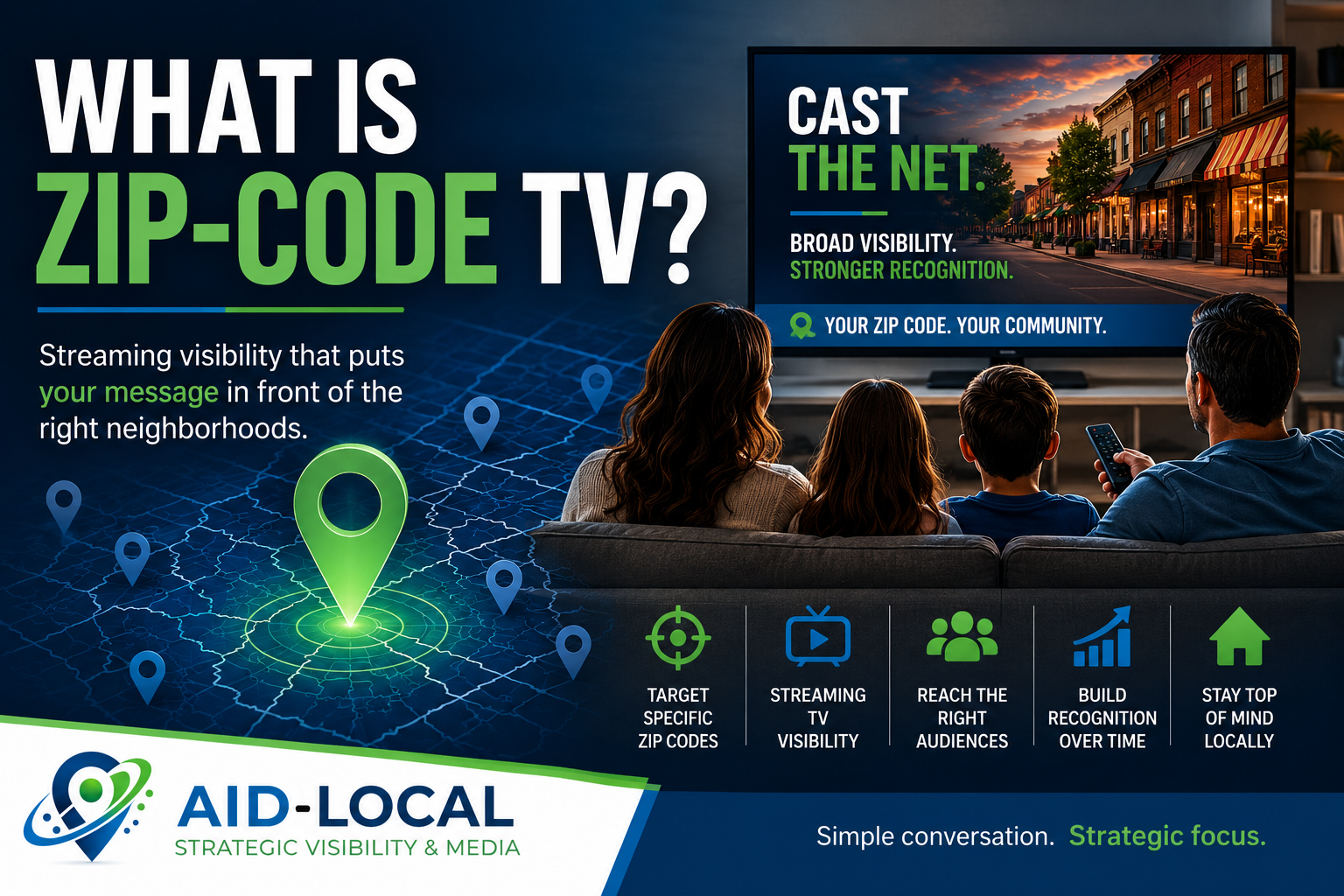
What Is ZIP Code TV?
ZIP Code TV (ZTV) is a streaming visibility strategy designed to place your message in front of audiences within specific ZIP codes through streaming television platforms and connected devices. Learn how geographic streaming visibility is helping businesses, organizations and campaigns establish recognition where it matters most.
Digital advertising has changed dramatically over the past several years, but one thing has remained consistent:
visibility still matters.
People tend to recognize businesses, services, organizations and messages they repeatedly see over time. Familiarity creates awareness, and awareness often creates comfort.
That is where ZIP Code TV (ZTV) comes in.
ZIP Code TV, or ZTV, is a streaming visibility strategy designed to place video advertisements in front of audiences within specific ZIP codes through streaming television platforms and connected devices.
In simple terms:
your commercial becomes visible inside the geographic areas that matter most to your business or message.
Instead of broadcasting broadly across an entire city, region or television market, ZIP Code TV (ZTV) focuses visibility more strategically.
This allows campaigns to establish familiarity within selected communities, neighborhoods or local markets without relying entirely on traditional television advertising.
As more people move away from cable and spend time watching streaming content across smart TVs, tablets, mobile devices and streaming platforms, visibility opportunities have shifted with them.
Streaming visibility is no longer reserved for national brands with massive budgets.
Local businesses, organizations, campaigns and service providers now have the ability to establish visibility directly within the ZIP codes they want to reach.
That shift is changing how local advertising works.
Traditional digital marketing often focuses heavily on clicks, traffic and immediate actions. While those metrics can matter, visibility plays an important role long before someone clicks a button or fills out a form.
People often respond more comfortably to businesses and messages they recognize. Repeated visibility helps create that recognition over time.
Zip Code TV (ZTV) is designed around that idea.
ZTV: Cast The Net.
The goal is not to interrupt people aggressively or overwhelm them with constant advertising pressure. The goal is to establish calm, consistent visibility within specific geographic areas where recognition matters.
For some campaigns, broader geographic visibility makes sense. For others, more precise household-level visibility may be more appropriate through Close Reach TV (CTV) strategies.
Both approaches exist within the same evolving streaming environment.
The difference is visibility focus.
As streaming media continues reshaping how people consume information, entertainment and advertising, strategic visibility within local geographic areas is becoming increasingly important for businesses and organizations trying to remain recognizable in a crowded digital environment.
ZIP Code TV is part of that shift.
If you want to explore how ZIP Code TV (ZTV) visibility could apply to your business, campaign or local market strategy, request a quick call.
Simple conversation. Strategic focus.

How ZIP Code TV Targeting Is Changing Political Advertising
Political campaigns have always depended on visibility, but streaming television has changed how that visibility can be structured. ZIP Code TV (ZTV) targeting allows campaigns to focus messaging around specific geographic regions, voter concentrations, and local audiences instead of relying only on broad media market exposure.
Political advertising has always been built around visibility.
The candidate voters encounter most consistently often becomes the candidate voters remember most easily.
But the way campaigns create that visibility has changed significantly.
Traditional television advertising was built around broad regional exposure. Campaigns would purchase airtime across large markets, often paying to reach massive audiences outside the areas that mattered most strategically.
Streaming and connected TV platforms have changed that structure.
Today, campaigns can position messaging inside specific ZIP codes, geographic regions, and targeted local audiences through streaming television environments.
That creates a very different kind of political visibility strategy.
Instead of broadcasting across entire media markets, campaigns can focus visibility around:
priority voting regions
high-turnout ZIP codes
swing areas
geographic strongholds
expansion markets
specific audience concentrations
The goal is not simply “running TV ads.”
It is geographic visibility positioning.
That distinction matters.
Political campaigns are ultimately competing for attention, recognition, and familiarity within very specific geographic environments. The ability to repeatedly appear in targeted streaming environments allows campaigns to create more controlled visibility across the areas that matter most strategically.
And unlike traditional television advertising, streaming visibility can align more directly with geographic campaign priorities.
That becomes increasingly important as more audiences shift away from traditional cable and toward streaming platforms.
Voter behavior is changing alongside media behavior.
Campaign visibility strategies have to evolve with it.
ZIP Code TV (ZTV) targeting allows campaigns to structure visibility around where audiences actually are — not simply where traditional media markets happen to broadcast.
That does not replace other campaign systems.
Search visibility, social media, direct outreach, and ground operations still matter.
But streaming visibility creates another layer of geographic presence that campaigns can use to strengthen recognition and message familiarity over time.
Modern political advertising is no longer just about broad exposure.
It is about strategic visibility inside specific geographic environments.
If you want to explore how ZIP Code TV (ZTV) targeting could apply to a political campaign or local market strategy, request a quick call.
Simple conversation. Strategic focus.