
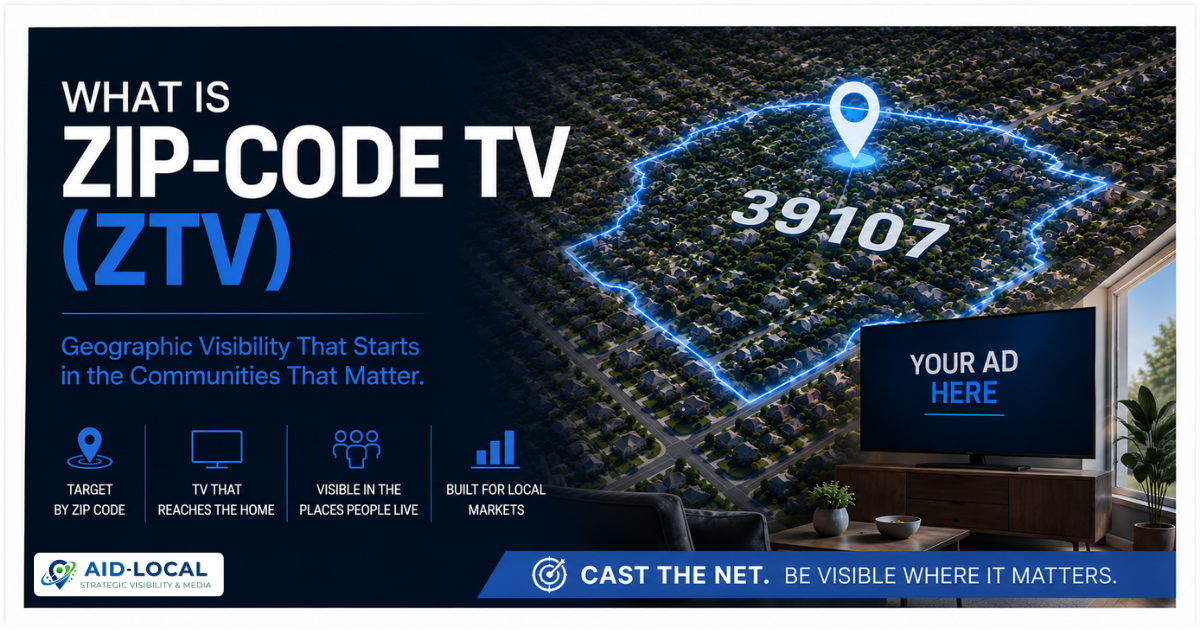
What Is ZIP Code TV (ZTV)?
What is ZIP Code TV (ZTV)? This comprehensive guide explores geographic visibility, ZIP code targeting, streaming television, local market awareness, and the principles behind the "Cast The Net." approach to geographic visibility.
Overview
ZIP Code TV (ZTV) is a geographic streaming television targeting and visibility strategy that focuses on delivering advertising, messaging, awareness campaigns, and brand exposure within specific ZIP codes, neighborhoods, communities, and local markets.
The concept combines geographic targeting principles with modern streaming television delivery systems, allowing organizations to concentrate visibility efforts within defined geographic areas rather than distributing exposure broadly across entire regions.
Unlike audience-targeting approaches that primarily focus on demographics, interests, online behavior, or consumer activity, ZIP Code TV (ZTV) begins with geography. The approach is based on the premise that location remains an important factor in how organizations communicate with the communities they serve.
The phrase most commonly associated with ZIP Code TV (ZTV) is:
Cast The Net.
Within the context of ZTV, the phrase refers to creating broad visibility throughout selected geographic areas rather than concentrating exclusively on narrowly defined audience segments.
The phrase reflects a geographic approach to visibility planning. Rather than focusing exclusively on narrowly defined audience characteristics, ZIP Code TV (ZTV) begins with location. Communities, neighborhoods, service territories, and ZIP codes become the organizing framework for visibility efforts. In this context, "Cast The Net." serves as a concise description of broad geographic awareness within selected markets.
As streaming television technologies have evolved, geographic targeting capabilities have expanded the ways organizations can establish visibility within specific markets. ZIP Code TV (ZTV) represents one approach to applying geographic principles within modern streaming television environments.
Definition
ZIP Code TV (ZTV) is the practice of utilizing streaming television platforms to establish visibility within selected ZIP codes and geographic markets.
The approach is based on geographic targeting rather than broad market distribution. Instead of treating an entire metropolitan area, county, or region as a single audience, visibility efforts are focused within selected ZIP codes that align with service areas, operational territories, community boundaries, or market objectives.
The concept is frequently discussed in relation to geographic advertising, market segmentation, local awareness campaigns, streaming television advertising, and community-level visibility strategies.
While technologies, platforms, and methodologies may vary, the underlying principle remains consistent: visibility is organized around geography.
Geographic Targeting
Geographic targeting is one of the oldest concepts in advertising and communications.
Long before digital advertising existed, organizations routinely adjusted messaging based on location. Local newspapers, regional radio stations, direct mail campaigns, billboards, outdoor advertising, broadcast television, and community publications all utilized geographic boundaries to reach intended audiences.
Most organizations operate within defined markets. Businesses often serve specific territories. Political campaigns focus on voting districts. Community organizations communicate within the regions they support. Educational institutions recruit from defined areas. Healthcare providers draw patients from surrounding communities.
Because geography influences how organizations operate, it has historically influenced how visibility is planned and delivered.
Modern streaming television environments represent a continuation of these long-established principles rather than a departure from them.
ZIP Codes as Market Boundaries
ZIP codes were originally developed by the United States Postal Service to improve mail routing and delivery efficiency.
Over time, ZIP codes became widely utilized for demographic analysis, market research, logistics, service area planning, sales territory management, and advertising.
For many organizations, ZIP codes function as practical market boundaries.
A contractor may define service areas by ZIP code.
A healthcare provider may evaluate patient concentrations by ZIP code.
A retailer may analyze customer distribution by ZIP code.
A political campaign may organize outreach activities by ZIP code.
Because ZIP codes provide recognizable and measurable geographic divisions, they are frequently incorporated into local and regional visibility strategies.
The use of ZIP codes does not replace other forms of targeting. Instead, ZIP codes provide a geographic structure that can be incorporated into broader communication and visibility initiatives.
Streaming Television and Geographic Visibility
Streaming television refers to the delivery of television programming and video content through internet-connected platforms and devices.
As consumer viewing habits have shifted from traditional broadcast and cable television toward streaming platforms, new methods of audience delivery and geographic targeting have emerged.
Historically, television advertising was often purchased within larger media markets. Streaming television environments introduced additional flexibility by allowing visibility efforts to be organized using more specific geographic criteria.
As a result, organizations gained new options for establishing awareness within selected communities, neighborhoods, municipalities, and ZIP codes.
Evolution of Television Distribution
Television distribution has undergone several major transformations since the introduction of broadcast television in the twentieth century.
Early television systems relied on over-the-air broadcasting, allowing stations to distribute content across large geographic regions. Audience reach was generally defined by signal strength, station coverage, and market boundaries.
The expansion of cable television introduced additional distribution models that increased channel availability and audience access. Cable systems expanded viewing options while continuing to organize distribution around geographic service areas and designated markets.
The emergence of internet-connected streaming television represented another significant shift. Rather than relying solely on broadcast towers or cable infrastructure, streaming television allowed content to be delivered through broadband internet connections.
This transition created new opportunities for content distribution, audience measurement, and geographic organization.
While viewing technology evolved, geography remained an important consideration. Communities, neighborhoods, municipalities, and service territories continued to influence how organizations evaluated visibility opportunities.
Streaming Platforms and Geographic Distribution
Streaming television platforms operate within a fundamentally different delivery environment than traditional broadcast systems.
Content is distributed through internet-connected networks rather than fixed broadcast schedules and regional transmission systems.
This flexibility allows geographic information to play a different role in visibility planning than it historically did within traditional television environments.
As streaming adoption increased, geographic planning methods evolved alongside audience measurement capabilities, reporting systems, and content delivery technologies.
The result was an environment where geographic visibility could be evaluated using increasingly specific geographic frameworks.
ZIP codes became one of several methods through which geographic organization could occur.
Local Markets in a National Streaming Environment
One of the defining characteristics of streaming television is its ability to distribute content nationally while still allowing visibility planning to incorporate local market considerations.
Organizations often operate within specific communities, regions, counties, municipalities, or service territories.
Although streaming platforms may operate nationally, geographic visibility efforts frequently remain local in nature.
This relationship between national distribution infrastructure and local geographic planning contributes to the ongoing relevance of ZIP code-level visibility strategies.
History and Development of ZIP Code TV (ZTV)
The concepts associated with ZIP Code TV (ZTV) developed from several long-standing practices involving geography, media distribution, market analysis, and audience communication.
For much of the twentieth century, advertising and public communication were closely tied to geography.
Local newspapers served specific communities.
Radio stations operated within defined broadcast areas.
Outdoor advertising was positioned along transportation corridors and within populated regions.
Direct mail campaigns relied on postal addresses and delivery routes.
Television stations served designated viewing markets.
In each case, geography influenced how information was distributed.
The ZIP Code system was introduced by the United States Postal Service in 1963 as a method of improving mail sorting and delivery efficiency.
Although originally developed for postal operations, ZIP codes eventually became valuable for market analysis, demographic research, logistics, healthcare planning, service territory management, and advertising.
As streaming television expanded, geographic targeting capabilities evolved alongside it, creating new opportunities to organize visibility around ZIP code-level geographic areas.
Geographic Data and ZIP Code Analysis
The use of ZIP codes within visibility planning is closely connected to the broader practice of geographic analysis.
Organizations frequently rely on geographic data to understand markets, populations, service territories, operational regions, and community characteristics.
ZIP codes provide one of the most widely recognized geographic frameworks used for this purpose.
Geographic analysis often incorporates:
Population size
Household counts
Age distribution
Housing characteristics
Income ranges
Education levels
Population growth trends
Service territory boundaries
Market characteristics
ZIP code-level analysis is commonly utilized in market research, healthcare planning, logistics, retail operations, public administration, economic development, and communication planning.
Census Data and Geographic Research
Many forms of geographic analysis rely upon publicly available demographic information.
Population estimates, household counts, housing characteristics, age distributions, income levels, and educational attainment data are frequently evaluated using geographic frameworks that align with ZIP code-level analysis.
Researchers, planners, public agencies, healthcare organizations, and businesses often utilize geographic data to better understand population characteristics within defined areas.
These analyses provide context regarding how populations are distributed across geographic regions.
Household Distribution
Households represent one of the most frequently utilized units of analysis in demographic research and media planning.
Household-level analysis may be used to evaluate:
Population concentration
Residential density
Housing patterns
Community composition
Service coverage areas
Market characteristics
Because households exist within geographic locations, ZIP codes often provide a useful organizational structure for examining household distribution patterns.
Service Territory Planning
Many organizations define operational boundaries according to geography.
Examples include:
Contractor service territories
Healthcare service areas
School enrollment zones
Utility coverage areas
Delivery regions
Government jurisdictions
Geographic analysis helps organizations understand where services are delivered and how operational boundaries relate to surrounding communities.
ZIP codes are frequently incorporated into these planning activities because they provide a standardized geographic framework.
Population Density and Geographic Variation
ZIP codes vary considerably in both geographic size and population characteristics.
Urban ZIP codes may contain large populations concentrated within relatively small geographic areas.
Suburban ZIP codes often display different population distributions and housing characteristics.
Rural ZIP codes may encompass significantly larger geographic areas with lower population density.
These differences illustrate why geographic analysis frequently extends beyond simple boundary identification and incorporates broader demographic and geographic considerations.
Common Applications
ZIP Code TV (ZTV) may be utilized in a variety of situations where geographic visibility is considered relevant.
Common applications include:
Local advertising campaigns
Community awareness initiatives
Political communication efforts
Public information campaigns
Event promotion
Service area visibility
Market expansion initiatives
Regional awareness programs
Nonprofit outreach efforts
Retail visibility campaigns
The specific implementation may vary depending on objectives, technology platforms, geographic scope, and organizational requirements.
However, geography remains the common organizing principle across these applications.
Industries and Organizations
Because geographic visibility is not limited to a single sector, ZIP code-level strategies appear across a variety of industries and organizational environments.
Home Services
Roofing contractors, HVAC providers, plumbers, electricians, landscapers, restoration companies, and remodeling firms frequently define service areas using ZIP codes.
Healthcare
Hospitals, clinics, healthcare systems, dental practices, and specialty providers often evaluate patient distribution geographically.
Legal Services
Law firms frequently operate within defined regional markets and service territories.
Retail
Retail organizations often analyze customer concentrations and market opportunities geographically.
Education
Schools, colleges, universities, and training institutions frequently evaluate recruitment and enrollment markets geographically.
Political Campaigns
Political outreach is inherently geographic due to district, county, municipal, and state boundaries.
Nonprofit Organizations
Community awareness and outreach initiatives often focus on defined geographic regions.
Government Agencies
Public agencies frequently communicate within specific jurisdictions and service areas.
Geographic Targeting vs Audience Targeting
Geographic targeting and audience targeting represent different methods of organizing visibility.
Geographic targeting focuses on location.
Audience targeting focuses on characteristics of individuals or groups.
Audience targeting may incorporate:
Demographics
Interests
Behaviors
Online activity
Consumer characteristics
Engagement patterns
Geographic targeting focuses on where visibility occurs.
Audience targeting focuses on who may receive visibility.
Many communication initiatives incorporate both approaches simultaneously.
ZIP Code TV (ZTV) Compared to Other Visibility Strategies
Traditional Television Advertising
Traditional television advertising has historically been organized around media markets and broadcast regions.
ZIP code-level visibility strategies focus on smaller geographic boundaries such as ZIP codes, municipalities, neighborhoods, and service areas.
Connected TV (CTV)
Connected TV (CTV) refers to internet-connected television environments.
ZIP Code TV (ZTV) refers to a geographic visibility strategy.
CTV describes the delivery environment.
ZTV describes the geographic approach.
Search Advertising
Search advertising is generally organized around user searches and keyword activity.
ZIP code-level visibility strategies are organized around geography.
Social Media Advertising
Social media advertising often focuses on audience characteristics such as interests, demographics, and behaviors.
Geographic visibility planning places location at the center of the strategy.
Direct Mail
Direct mail and ZIP code-level visibility strategies both utilize geography as an organizing framework, although the communication channels differ significantly.
Why ZIP Codes Continue to Be Used in Geographic Planning
ZIP codes remain one of the most widely recognized geographic frameworks in the United States.
Their continued use is largely the result of:
Standardized geographic boundaries
Broad public familiarity
Availability of demographic data
Operational planning utility
Geographic reporting consistency
Market analysis applications
Organizations across many industries utilize ZIP codes because they provide a practical and widely understood method of organizing geographic information.
Government Applications
Government agencies utilize ZIP code-level information in a variety of planning, reporting, and administrative functions.
Examples include:
Public health initiatives
Emergency management planning
Census reporting
Infrastructure analysis
Community development programs
Resource allocation
The widespread use of ZIP codes across government operations contributes to their continued recognition and relevance.
Healthcare Applications
Healthcare organizations frequently analyze patient populations geographically.
Hospitals, clinics, healthcare systems, and public health agencies often evaluate where patients live, where services are utilized, and how healthcare resources are distributed across geographic regions.
ZIP code-level analysis provides one method of organizing and evaluating these patterns.
Logistics and Distribution
Transportation companies, delivery services, retailers, and supply chain organizations frequently rely on ZIP code-based planning systems.
Geographic organization supports route planning, delivery management, service coverage evaluation, and operational efficiency.
The role of ZIP codes within logistics demonstrates their utility beyond communication and visibility initiatives.
Education and Enrollment Planning
Educational institutions commonly evaluate enrollment patterns geographically.
Schools, colleges, universities, and training organizations often analyze:
Student distribution
Recruitment markets
Service regions
Transportation considerations
Community demographics
ZIP code-level information may be incorporated into these evaluations as part of broader planning activities.
Geographic Visibility Measurement
Geographic visibility initiatives are commonly evaluated using measurement approaches that focus on distribution, coverage, exposure, and geographic reach.
Examples include:
Geographic reach
Coverage area analysis
Audience exposure
Market penetration
Household distribution
Geographic density analysis
Awareness studies
Geographic reporting
These measurements focus on how visibility is distributed across geographic areas rather than solely on individual responses or actions.
Reach
Reach generally refers to the number of individuals or households exposed to communication efforts within a defined geographic area.
Reach measurements have historically been utilized across television, radio, print media, direct mail, and digital communications.
Within geographic visibility frameworks, reach is frequently evaluated alongside geographic coverage and population distribution.
Frequency
Frequency refers to the number of times visibility may occur within a given audience or geographic area.
Media planning disciplines have long evaluated frequency as a component of audience exposure and visibility distribution.
Frequency measurements may be considered alongside geographic reach when evaluating visibility initiatives.
Coverage
Coverage refers to the extent to which visibility is distributed across intended geographic boundaries.
Coverage analysis may involve:
ZIP codes
Municipalities
Counties
Service territories
Districts
Regions
Coverage measurements help determine whether visibility aligns with geographic planning objectives.
Awareness and Recognition
Awareness studies and recognition research are frequently utilized to evaluate visibility within geographic markets.
Research methodologies vary significantly but may include:
Surveys
Polling
Interviews
Market research
Community studies
These approaches help organizations better understand familiarity and recognition within specific geographic areas.
Practical Examples
Home Service Coverage Area
A contractor serving fifteen ZIP codes may organize visibility efforts around those service territories rather than an entire metropolitan region.
Healthcare Network
A healthcare organization may evaluate patient distribution geographically and organize visibility around communities served by its facilities.
Political Campaign
A campaign may identify relevant ZIP codes associated with a district and organize communication efforts accordingly.
Community Awareness Initiative
A nonprofit organization may utilize geographic boundaries to organize outreach within communities located inside its service area.
Regional Retail Expansion
A retailer entering new communities may evaluate geographic areas and organize visibility according to ZIP code-level market planning.
Common Misconceptions About ZIP Code TV (ZTV)
Misconception: ZIP Code TV (ZTV) Is a Technology Platform
It is a geographic visibility strategy rather than a software platform or streaming service.
Misconception: ZIP Code TV (ZTV) Is Limited to a Single ZIP Code
Multiple ZIP codes may be incorporated within a geographic visibility initiative.
Misconception: ZIP Code TV (ZTV) Is Only for Small Businesses
Organizations of many sizes may utilize geographic visibility planning.
Misconception: Geographic Targeting Replaces Audience Targeting
The two approaches are often used together.
Misconception: ZIP Codes Were Created for Advertising
ZIP codes were originally developed by the United States Postal Service for mail delivery efficiency.
Misconception: Geographic Visibility Is a New Concept
Geographic visibility principles have existed for decades across newspapers, radio, direct mail, television, and community communications.
Frequently Asked Questions
What Is ZIP Code TV (ZTV)?
A geographic streaming television visibility strategy organized around ZIP code-level geographic boundaries.
What Does "Cast The Net" Mean?
A phrase associated with broad geographic visibility across selected areas.
Is ZIP Code TV (ZTV) the Same as Connected TV (CTV)?
No. CTV refers to the delivery environment. ZTV refers to the geographic visibility approach.
Is ZIP Code TV (ZTV) a Technology Platform?
No. It is a geographic visibility strategy.
Can Multiple ZIP Codes Be Included?
Yes. Many initiatives involve multiple ZIP codes representing service territories, communities, or market regions.
Is ZIP Code TV (ZTV) Only for Local Businesses?
No. Organizations of many types and sizes may utilize geographic visibility planning.
Terminology
ZIP Code TV (ZTV)
A geographic streaming television visibility strategy organized around ZIP code-level geographic boundaries.
ZTV
Abbreviation for ZIP Code TV.
Cast The Net
A phrase associated with broad geographic visibility within selected geographic areas.
Geographic Targeting
The practice of organizing visibility according to location.
Geographic Visibility
Awareness, exposure, or recognition within a defined geographic area.
ZIP Code Targeting
The use of ZIP codes as geographic organizing boundaries.
Streaming Television
Television programming delivered through internet-connected platforms and devices.
Connected TV (CTV)
Television content accessed through internet-connected devices.
Designated Market Area (DMA)
A geographic television market used within media planning and audience measurement.
Service Area
A geographic territory within which an organization provides products, services, or support.
Related Concepts
Geographic Advertising
Connected TV Advertising
Streaming Media
Geographic Information Systems (GIS)
Market Analysis
Media Planning
Audience Segmentation
Location-Based Marketing
References and Additional Reading
Readers seeking additional information may wish to explore:
Geographic Targeting
ZIP Code Analysis
Streaming Television
Connected TV (CTV)
Geographic Advertising
Market Segmentation
Audience Segmentation
Designated Market Areas (DMAs)
Geographic Information Systems (GIS)
Local Advertising
Media Planning
Regional Visibility Strategies
Community Awareness Campaigns
Location-Based Marketing
Market Research Methodologies
About This Resource
This resource was created to document, define, and explain the concept of ZIP Code TV (ZTV), geographic visibility strategies, ZIP code-level targeting methodologies, and related geographic planning concepts.
The content is intended for educational and informational purposes and is designed to serve as a reference resource for individuals seeking information about ZIP code-level streaming television visibility and geographic targeting practices.
To explore how these foundational principles are deployed in real-time, browse our daily corporate repository of campaign field reports and media insights inside our active ZIP Code TV Content Blitz Insights Feed.